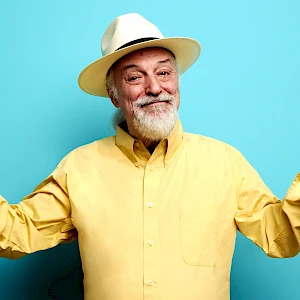
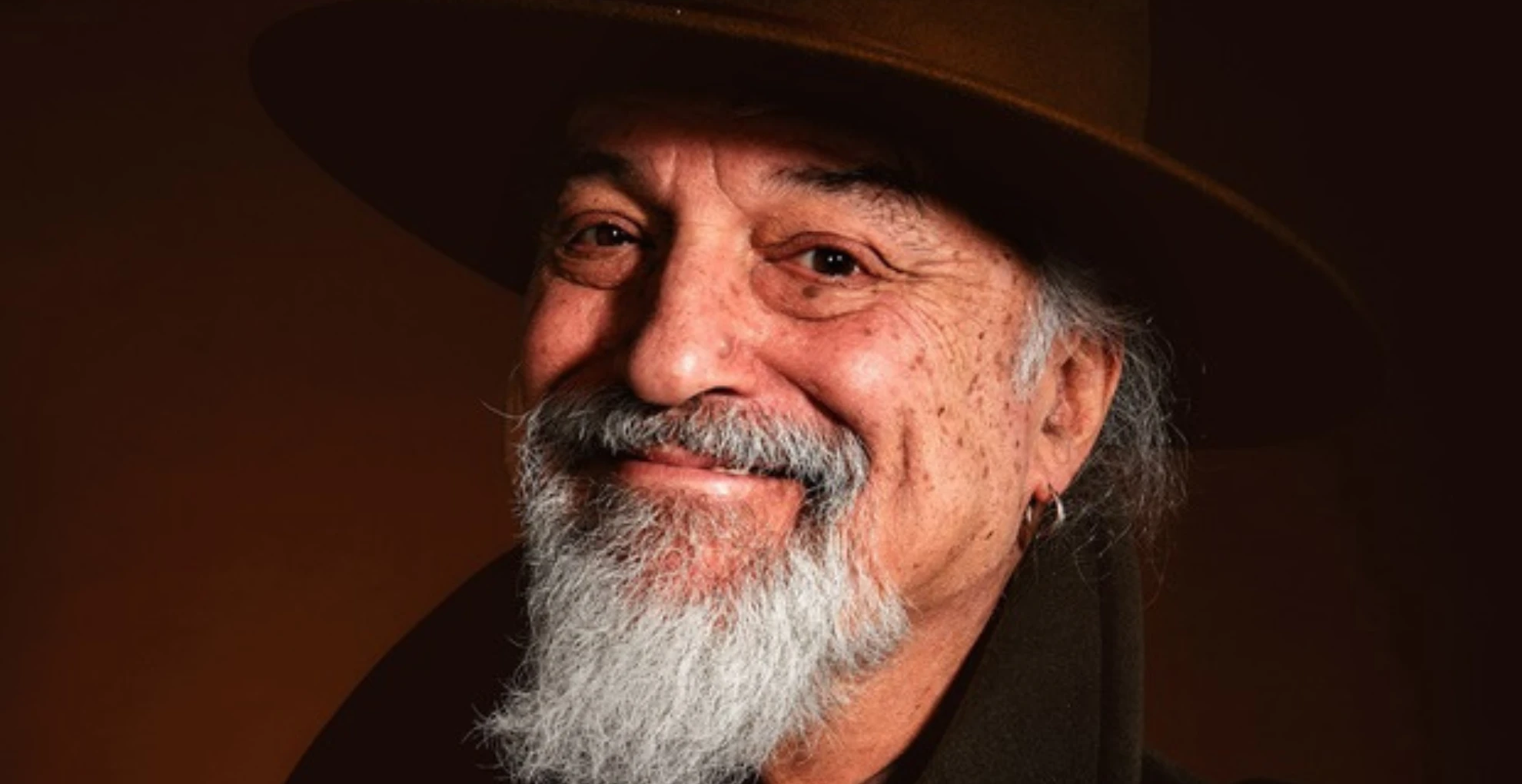
EUGENIO FINARDI
THE BIOGRAPHY
EUGENIO FINARDI
Biography
Before colors, tastes, or scents — before touch itself — Eugenio first heard the Voice.
His mother, Eloise, was a coloratura soprano, and developing his hearing within such an extraordinary instrument inevitably shaped him into a devoted explorer of singing, of the voice as pure sound beyond the words that rest upon it.
This deep bond with sound led him to cross paths with many leading figures of Italian music while always pursuing a highly personal artistic vision.
At the age of twenty, he signed with Numero 1, the label founded by Mogol and Lucio Battisti. He had been noticed by Mara Maionchi while moving within the Milan underground scene alongside Alberto Camerini, Ivan Graziani, Claudio Rocchi, and Demetrio Stratos, who became a kind of older brother figure to him.
In 1973 he released the English-language single Spacey Stacey, around the same time as Demetrio’s own releases. When Stratos founded AREA, Finardi followed him to Gianni Sassi’s Cramps label, where he released five albums that helped lay the foundations of Italian rock.
Songs such as Musica Ribelle, Extraterrestre, Scimmia, and La Radio introduced a new kind of songwriting — raw and direct lyrics combined with complex musical structures infused with jazz and classical influences, shaped by distinctly Italian harmonic and rhythmic sensibilities.
After concluding his phase as a politically engaged singer-songwriter around 1980, he recorded with British musicians a series of tracks in both English and Italian, resulting in Finardi and Secret Streets, perhaps his most purely rock-oriented albums.
The birth of his daughter Elettra, who has Down syndrome, prompted an unexpected personal transformation, inspiring deeply introspective works such as Dal Blu, Dolce Italia, and Il Vento di Elora, alongside more uncertain steps such as his first Sanremo appearance (co-written with Franco Battiato).
In the 1990s he signed with Warner, his first major label, achieving his greatest commercial success with La Forza dell’Amore. This was followed by Millennio and Acustica, the first Italian unplugged album, where he also interpreted songs by Chico Buarque, Jimi Hendrix, and Harry Belafonte.
In 1996 he traveled to New York to record Occhi at the legendary Power Station Studios with top session musicians. The album includes Uno di Noi and especially Un Uomo, perhaps his most complex and profound work both lyrically and musically, featuring key changes in every verse and a demanding vocal line requiring constant shifts in register and vocal approach — delivered with a lightness and intensity that make it seem effortless. Eugenio had rediscovered his voice.
He returned to Sanremo in 1999 with Amami Lara, an experience that highlighted once again his distance from mainstream pop music.
At the turn of the millennium, he began a tradition of revisiting and reinterpreting his earlier songs each decade, taking stock of his artistic evolution and vocal research.
In 2002, with Cinquantanni, he concluded his contract with the multinational label and stepped away from the mainstream recording system. Since then, he has released albums of Portuguese fado, the deeply authentic project Anima Blues, and Il cantante al microfono, dedicated to the songs of Vladimir Vissotsky — earning the Targa Tenco for interpretation. In 2010 he successfully opened the youth concert season at Teatro alla Scala in Milan, repeating the experience the following year with the Entr’acte ensemble.
With Sessanta (2012), he presented his entire repertoire live, including the song performed at that year’s Sanremo Festival. Fibrillante (2014) is his latest album of original material, returning to the spirit of early Finardi: committed, uncompromising. On the occasion of the 40th anniversary of his career, Universal released the box set 40 anni di Musica Ribelle, featuring remastered versions of his first five Cramps albums.
The profound silence of the lockdown inspired Euphonia Suite, an extraordinary project (with Mirko Signorile and Raffaele Casarano) creating a continuous sonic flow in which individual pieces become verses within a broader musical and textual narrative.
With Euphonia Suite, Eugenio reaches new artistic heights, showcasing the full range of his vocal expression and confirming himself as one of the most versatile and sensitive interpreters on the Italian music scene.
Info & booking

Francesco Fabbri
francesco.fabbri@internationalmusic.it
Ufficio Stampa
Viviana Tasco
viviana.tasco@internationalmusic.it
THE DATE
OF THE TOUR