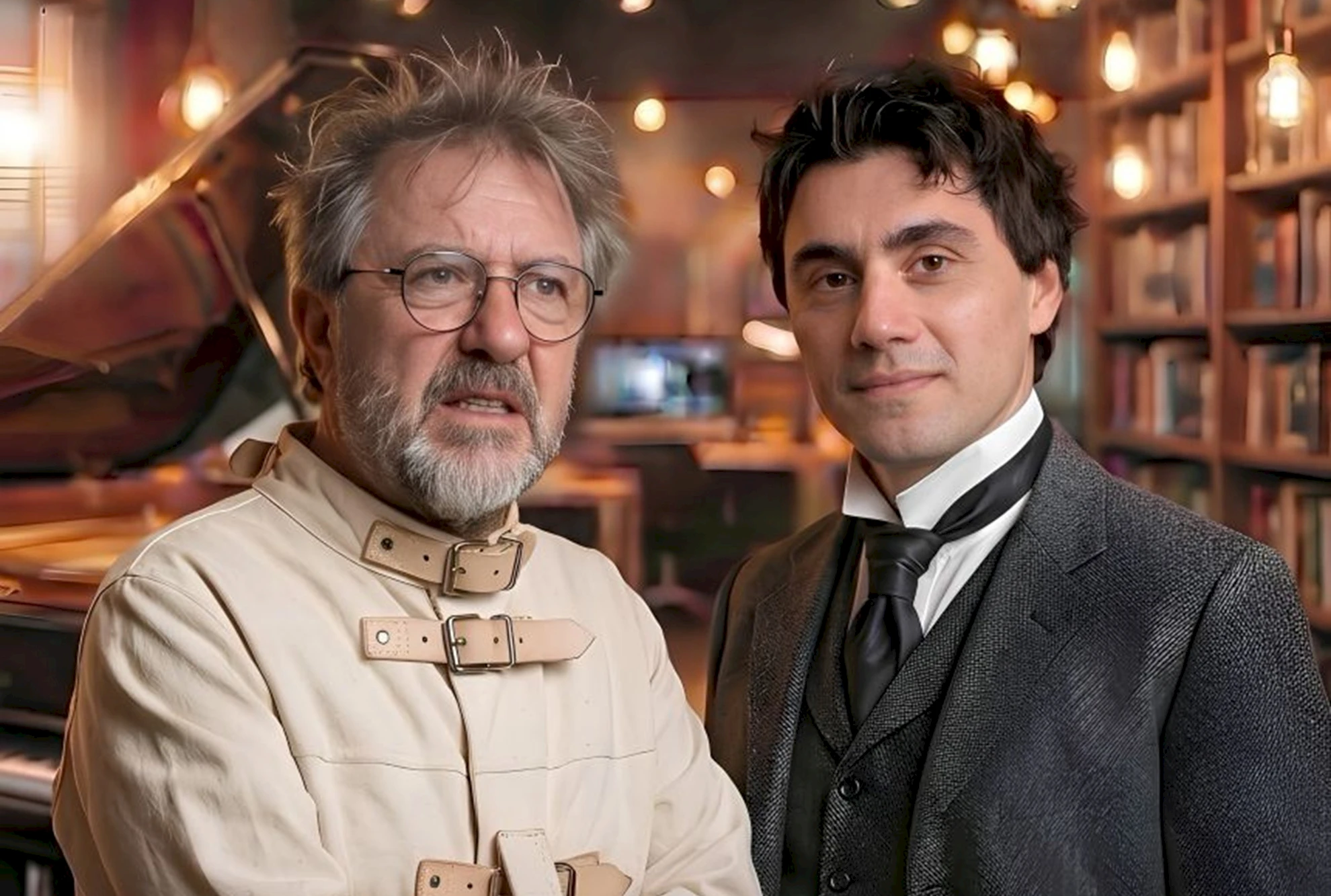
CLAUDIO PAOLUCCI & ROCCO TANICA
COM'È UMANO L'AI
Theater
COM'È UMANO L'AI
How Not to Fear the Galactic Mega-Director and Learn to Call It by Its First Name
with Claudio Paolucci & Rocco Tanica
Claudio Paolucci, one of Italy's leading academic voices in the field of artificial intelligence and an engaging public communicator following in the footsteps of his mentor Umberto Eco, joins forces with Rocco Tanica, who has enriched his long career as an innovative artist through years of experimentation with AI, for a conference-performance designed as an accessible, interactive journey into the most transformative technological development of recent times: generative artificial intelligence in the service of creativity.
As Claudio Paolucci explains:
"For the first time, we are faced with language-enabled machines capable of generating songs, images and videos through an ordinary chat conversation. It is natural to feel disoriented, because for the first time in human history machines can perform tasks that, for centuries, we believed to be uniquely human. Yet AI is simply the latest in a long line of external tools to which we have always delegated part of our mental work in order to improve and make more efficient our relationship with one another and with the world—from writing to computers, the internet and smartphones."
The human mind has never been confined solely to the brain. It has always extended into the objects and technologies we create and use. Our integration with technology is therefore not unnatural; on the contrary, it is one of the defining characteristics of what makes us human. The evolution of our species has always been driven by cultural tools that have expanded the power and efficiency of the mind. Artificial intelligence is simply the latest of these tools, but one that promises to reshape many of our cognitive processes in unprecedented ways, revealing patterns, connections and possibilities that were previously beyond our reach. Learning to use it creatively is therefore one of the defining challenges of our time.
As Rocco Tanica observes:
"Creativity—the most profoundly human of all activities—has always relied on technology, from cave paintings to frescoes, from traditional musical instruments to electronic ones, in order to become art and communicate worlds, emotions and ideas. These tools have, in turn, shaped and transformed the creative process itself. That artists today can also use AI to enhance and amplify their creativity is simply the natural next step."
During the event, Tanica will recount his own journey of discovering and "taming" artificial intelligence while demonstrating, live and with active audience participation, how today's leading generative AI tools create—and refine—texts, images, videos and music. Combining his trademark wit with practical demonstrations, he will explore how AI is transforming creative professions, showing that it need not diminish spontaneity or artistic quality, but can instead become a powerful expressive tool for those who learn how to use it thoughtfully.
AI is not the Galactic Mega-Director to be feared—we simply need to learn to call it by its first name. After all, AI doesn't pay our salaries; if anything, it's the other way around. How very human, AI is.