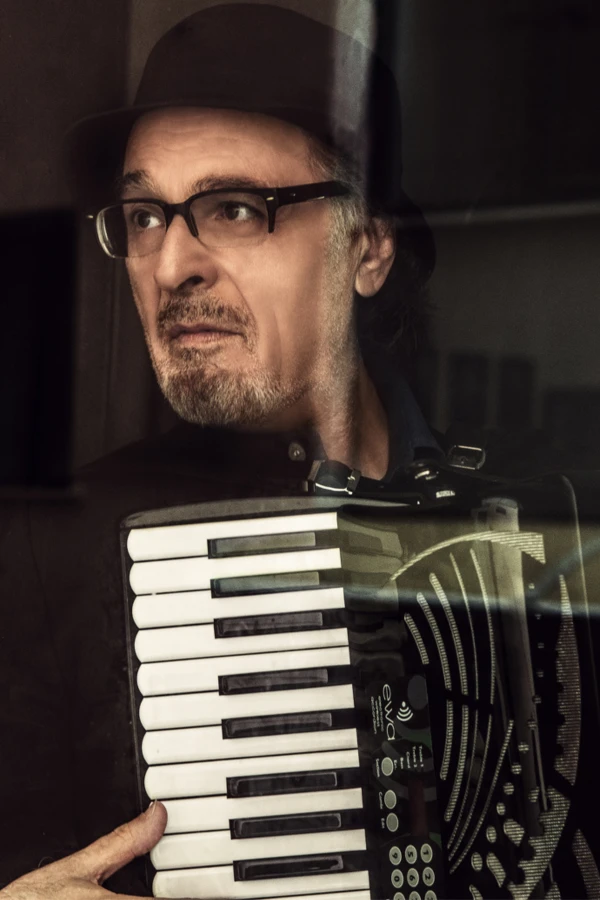
EDUARDO DE CRESCENZO
THE BIOGRAPHY
EDUARDO DE CRESCENZO
Biography
Born in Naples on February 8, 1951, Eduardo De Crescenzo is one of the most distinctive voices in Italian music: a singer-songwriter, composer, accordionist, arranger and performer whose artistic identity transcends genres and conventions.
His encounter with music came remarkably early. At the age of three he received his first accordion and immediately began playing by ear. By five, he was already performing as a child prodigy at Rome’s Teatro Argentina while pursuing classical music studies. Because the accordion was not yet recognized within Italian conservatories, his training took place privately.
After early competitions came the years of the complessi—the popular bands of the 1960s and 1970s. As soul, blues and jazz increasingly dominated the club scene, De Crescenzo temporarily set aside the accordion, which seemed out of step with the prevailing American-inspired sound, and turned to piano and keyboards. During those formative years he absorbed the music around him without yet fully realizing the depth of his own musical world—or the extraordinary potential of the voice that would later make him famous.
While continuing his education, first in accounting and then in law school, music remained his true calling.
His official breakthrough came in 1981 at the Sanremo Music Festival with Ancora. His voice burst onto the stage with extraordinary impact, earning him the Critics’ Award for Best Performer from a jury chaired by Sergio Leone. Written by Claudio Mattone and Franco Migliacci, Ancora quickly became an international success and remains one of the most beloved songs in Italian popular music. Selling millions of copies worldwide, it has become a timeless evergreen, later interpreted by major artists such as Mina, Ornella Vanoni and Mireille Mathieu, who recorded a French version adapted by Charles Aznavour. Yet De Crescenzo’s original interpretation remains unmatched.
His artistry, however, extends far beyond his vocal gifts. The richness of his musical language is rooted in a unique combination of talents as singer, composer, instrumentalist and arranger. Cultural critic Omar Calabrese described this quality in 1995, noting how De Crescenzo combines exceptional melodic ability with rigorous artistic refinement, creating performances that balance sophistication and emotional immediacy, while leaving room for improvisation, risk and surprise.
Throughout the 1980s and early 1990s, De Crescenzo returned several times to Sanremo with songs such as L’odore del mare (1987) and E la musica va (1991), consolidating his reputation as one of Italy’s most original musical voices.
Over time, he resumed composing his own material and returned to the accordion, the instrument of his roots. At the same time, he gradually distanced himself from television appearances and mainstream exposure, choosing instead the live concert as his preferred artistic dimension—one that allowed him to fully express the virtuosity and emotional depth of his music.
A decisive turning point came in 2012 with the launch of Essenze Jazz, a live project that reimagined his repertoire through a jazz-oriented lens. As De Crescenzo himself explained: “I am searching for a sound that can represent who I am today.” The project revealed the natural affinity between his intensely expressive, blues-infused vocal style and the openness of jazz language. His songs retained their lyrical and poetic essence while embracing improvisation and harmonic exploration, highlighting the extraordinary musicality that has always defined his work.
Today, Eduardo De Crescenzo remains a singular figure in Italian music: an artist whose Mediterranean sensibility, technical mastery and emotional depth continue to resonate across generations.
Selected Discography
- Essenze Jazz (2013)
- Le Mani – Live CD & DVD (2006)
- La Vita è un’Altra (2003)
- Live (1995)
- Danza Danza (1993)
- Cante Jondo (1991)
- C’è il Sole (1989)
- Nudi (1987)
- Dove c’è il Mare (1985)
- De Crescenzo (1983)
- Amico che Voli (1982)
- Ancora (1981)
Info & booking

Elisa Sitta
elisa.sitta@internationalmusic.it
Ufficio Stampa
Viviana Tasco
viviana.tasco@internationalmusic.it